
 3 gibbles out of 5

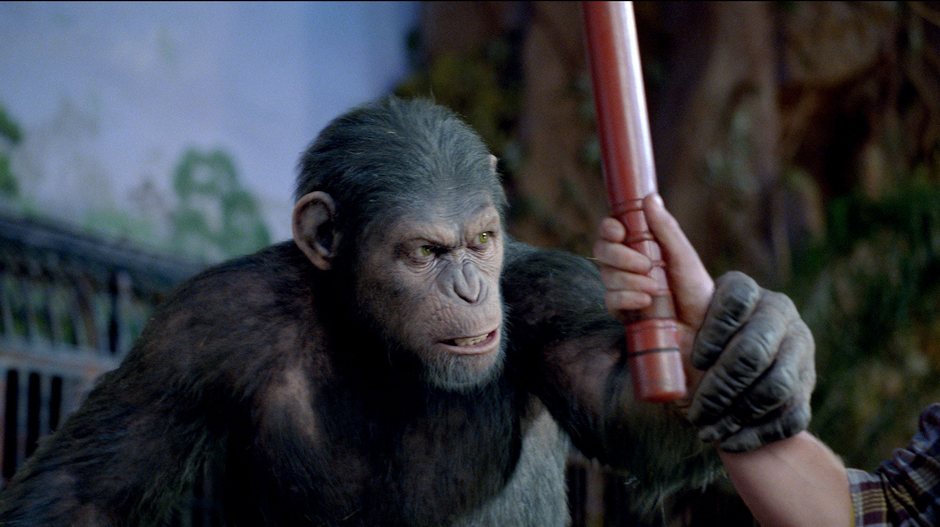
I don’t need any more pepper…
Director: Rupert Wyatt
I’m one of the ten people who actually enjoyed Tim Burton’s “Planet of the Apes.” I have no connection to the original series, so I just watched it like a movie. The costumes were pretty great, there were some good action sequences, and an involving enough light sci-fi campy plot thing. And a female ape that we’re oddly attracted to. “Rise” is a prequel. Beyond the obvious ones, there are scattered references to the series (minus Burton’s entry, which isn’t dare mentioned in “Rise”‘s extras), and once it gains the momentum to hurtle toward this setup, the movie gets better. The hour leading up to this, though, is pretty dumb, falling into all the obvious traps that big b-movies do.
So our boyfriend James Franco is a scientist, experimenting with serum ALZ-112 on apes. The serum is meant to regrow brain tissue, the end goal of curing Alzheimer’s. Right at the beginning of the film we get a “breakthrough” with the serum, where it suddenly works as desired on a test ape, and Franco scores a presentation with some potential benefactors. Like the majority of movie scientists, Franco isn’t required to do anything except drop a few keywords that let us know who knows some stuff. His approach to his work and the people around him is scripted, and not very scientific, making this nothing more than an obvious plot device. But oh well. Test ape goes bonkers and the project is shut down, as the serum is blamed for causing aggression. All the test apes are killed. But what’s this…? Post the bonkersness and the project failingness, it’s discovered it’s not the serum causing aggression, but that the ape had gotten pregnant and had baby in cage, and she was just projecting little baby. (Which, again, I’m sure scientists wouldn’t check for these things, especially in the big bucks business of unscrupulous ape testing.) Sensibly, Franco is given the little baby to take care of. When he realizes that the lil’ one has inherited the smart gene from his tested-on mom, Franco decides to continue private testing of the subject in his house.
This all happens in about five minutes, which is certainly one of my movie peevs. Heavy backstory = lets summarize it with a voice-over or 5 minute prologue. While I’m sure there are examples of this being used effectively, mostly it kills any initial tension (as generally this prologue is something major, reduced to small sentences that make it sound silly in summary (I’m looking at you, Milla-voice-over in Resident Evil)) or gives us too much flash right up front to settle down into a story. Again, there are exceptions… But “Rise” isn’t one of them. There would’ve been more graceful ways to introduce us to scientist Franco and his intelligent ape, Caesar, now living together in Caesar’s teenage-ish years, but the script takes the troped path and rides its B-movie horse.
Caesar protects his family at some point, but being a raging primate in a suburb just lands him in a primate sanctuary, where is domesticated lifestyle is looked down upon by the other apes, turning his identity issues into outward anger. The caretakers at the sanctuary are right out of every bad horror movie, torturing the animals they’re meant to care for and baiting them in unbelievable, eye-rolling, “you’re gonna die” ways. But it serves as the motivation for Caesar’s whipping his fellow apes up into a human-hating gang, culminating in the last third of the movie when the apes “rise.”
Now – most of this I’ve described as bad. It is. In an attempt to explore the roots, the movie gets over-serious and spends a lot of time plodding about to show us how all of this happens. Admittedly, it’s a difficult pitch with origin movies, as we’re probably expecting the thrills from whatever movie its the origin of, and generally the original story is the exciting one, so… It’s a difficult pitch. Forcing it to fit the framework of an action film makes it more difficult. And so “Rise” stumbles around fan service and big budget plotting, not really establishing anything well except for putting the pieces in place for apes vs. man. But once we get there – once Caesar’s mind is set and once the ball starts rolling – the movie can set aside its need for explanations and just take its forward momentum. Yes, it essentially becomes an action film at this point, but it also gets a sense of direction that feels justified instead of forced. It’s a minor distinction, but it’s enough to bump that last portion up to an enjoyable experience.
Of course, some notes about the special effects. Andy Serkis does do an amazing job as Caesar. The extras show just how much of his facial performance and mannerisms were put into the character, which is impressive from two sides – first how accurately mocap can capture this, and second how much of that performance actually is Andy, meaning he acted like an ape on set. The film wants to more patiently explore the domesticated wild animal scenario, and it’s just not given the room to do so, but Andy’s expressions show a full range of emotions that are mostly expressed only visually (no human character commenting “Are you upset? You feel unappreciated?”) and hint at a different film that would’ve been possible had this not needed to be stocked with action. The animation of the apes is also impressive, for as much mayhem ends up happening on screen. Alas… it’s still computer, and you can always tell. We’re still not at the point where these things blend 100% seamlessly, despite the immense effort put into the production. And that’s where Burton’s use of men in suits, felt a little more grounded and weighty. But there’s not a moment in the film that feels sloppy – everything is geared toward giving these computer apes presence, and it’s damned impressive.
So… perhaps I would’ve been cheering more if I loved the original series. But “Rise” doesn’t quite get the right tone for its first hour, lazily jumping from predictable moment to predictable moment. Once it settles into a direction and propels forward, it’s no more surprising but at least becomes dedicated, wrapped things up to become an overall enjoyable romp.
 vaguely-offensive