
 3 crampons out of 5

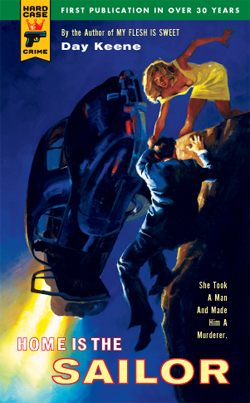
HCC 007
“Home is the Sailor” is of its era, when wives and husbands were intended as job title descriptions and girls were often slapped when they were acting “hysterical.” I liked Home is the Sailor. Lead character Swede Nelson is a big, brawly tough who always offers a curt line and has a smattering of notable, seedy genre characters. Keene even pushes things slightly above and beyond when Swede starts contemplating the nature of his life’s repeating cycles, but it never strays too far from its hard-boiled nature.
So Swede has just left years of service at sea behind to take a bundle of saved cash and settle down on a farm with a girl. He makes one stop for a night of drinking and wakes up in a motel court off a stretch of highway, no clue as to how he got there. A woman comes in the room and offers an ominous warning that he should get out. Then he meets the owner of the court, the dashing Corliss Mason, and falls quickly in love. But this love comes with a price, as Swede soon finds himself trying to cover up for a murder…
Keene pushes the narrative along at a quick and breezy pace. Swede doesn’t stop too much to contemplate where his last black-out bender has brought him. He also tends to think quick, and doesn’t mind thinking with his fists and mouth, so we jump from heavy scene to heavy scene as he digs himself deeper into a noir net. But he isn’t stupid. In the classic noir twist of morals, Swede is aware of the implications of his actions, but cannot help himself from acting due to his pursuits. Which, in noir, are either money, revenge, or women. It’s the latter in this one, as all is done in the name of Corliss Mason.
Having a woman as the raison d’etre can work. In a previous HCC book, Grifter’s Game, Lawrence Block used this effectively to run the lead character down a harrying slope of decisions. But in Sailor, it doesn’t stick as much. Beyond her beauty, Corliss doesn’t offer much that made me, as a reader, understand why any guy would fall for her. As soon as shit hits the fan, she goes completely bipolar, and Swede puts up with it in the name of his ultimate pursuit. Love makes people wacky, I get that, and certainly there are those who do fall fast and hard after one glance or one conversation, but within sentences, Swede is built as a heavy, and there’s not quite enough to explain why Corliss becomes the one.
Keene attempts to explore this later in the book, juxtaposing Ms. Mason with the tarts that had floated around Swede’s sailor life, and this is where the narrative elevates itself to something more… it wanders surrealistically through thoughts and moments, before Swede comes crashing back to the moment. It captures his slowly fractured state, as he imbibes more and more when questioning the purpose of his decisions, but he comes back to make another rushed decision fueled by anger or confusion.
No one’s going to mistake “Day is the Sailor” for a modern book. Some of the most surprising noirs read of their era but manage to become timeless in their characterizations. By writing a typical femme fatale who were just supposed to assume is the end-all be-all woman, Keene keeps the appeal of the book pretty much to genre fans. The plotting follows a similar logic, without much cloaking done to the core mystery, just keeping it to a straight forward momentum. So in this sense HCC book 07 perfectly matches their series, and is a good find, but the appeal will be limited.
 vaguely-offensive