

3 crampons out of 5
I thought reading Borges was going to get me chicks AND IT DID!
Giant lesions on my naked parts I call “chicks!”
The end.
This is not meant to be a commentary on the term chicks.
OR IS IT? COMMENTARY AND NOT COMMENTARY ARE THE SAME THING! THIS IS THE LESSON OF BORGES OMG
Many years ago, a lass whom I sought to impress mentioned Borges. “Sure, sure I’ve heard of him. Big fan. Read it. I know it. Love him. Good writer,” and so on, until she left me for a rodeo clown named Biggles. Some years ago, but less than the previous ‘many years ago,’ some other people kept saying “oh, like Borges” when I would describe the self-contained worlds in my stories. I killed these people. But not before asking myself: Who is this Borges? But I did kill them before dressing them up as rodeo clowns. So it was kill, then clowns, then the question. It’s important you recall this order.
Anyhow, so’s I finally done it, and read me a book by onea them there foreign non-americans. And I get it, ya ya, he’s very influential and incredibly smart and genius, but after you read a couple, you get the point. In the Ficciones collection, the stories are split into two section which end up following a chronological publication order. Whether the divide it creates would actually be felt if it weren’t forced upon the reader I cannot say, but the halving is beneficial in allowing us to settle into a different state of mind for both portions. Borges’ labyrinth, his well-known symbol, is apparent in almost every story as a representation – it seemed to me – of both the perceived complexity and repetitiveness of life, and (thus?) mirrored in every experience big and small. If you can deal with a Spanish man twiddling his mustache and smiling at you while you’re reading and you don’t mind some rather unnecessarily clever phrasings, you’ll enjoy Borges and this short story collection.
He didn’t have a mustache in the pictures I saw and I’m sure he was a nice guy. BUT WHAT DO YOU CARE. The point is: the first half of the book is, admittedly, awesome. In it, Borges is playful, and the inevitable wraparound twist at the end of each tale feels welcome, and… inevitable. Borges loved books and words and it’s obvious, such that the stories don’t feel like they’re trying to smack you with new concepts, but delighting in how they get entangled in this inescapable labyrinth. That sense of fun shifts in the second portion, however, especially in the last three tales, which were written 10 years after the previous one. This means the playfulness of the writer seems to twist into aging introspection. It could work separately, but included all together it makes those last 100 pages or so drag.
Should you read it? You already did, I’m thinking. But if you’re looking for a new book, this is a “rental”, a good experience to learn to read fiction in a new light (taking nothing for granted, in a way, as Borges was ought to gladly mix fiction and fact) and certainly earned it’s place in history, but doesn’t stand a chance next to such luminary tales as B.B. Hiller’s adaptations of the turtles movies.
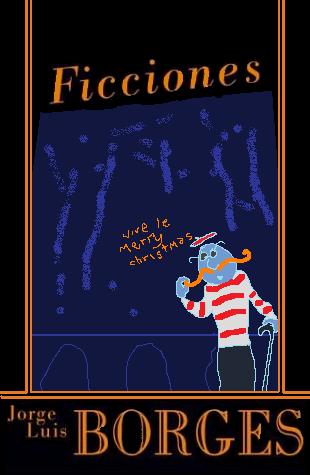
Blogger's rendition of cover (may not reflect actual artwork)
 vaguely-offensive