
 3 gibbles out of 5

Director: Nicolas Winding Refn
Mm. I was all set to love Drive. All the right people liked it, I dig Ryan Gosling, and the write-ups spoke of a blend of dark elements which normally make me purr. The opening scene had me convinced that I was about to be blown away by some moody awesomeness, but by film’s end I found myself almost completely unaffected.
‘Drive’ would seem to be a vehicle (ha ha) to explore groovy life stuff like expectations, or desires. Gosling plays an unnamed stunt car driver who moonlights as a getaway driver. His stoicism and strict adherence to rules seem to make him the best of the best, along with a seemingly straightforward take on morals and only taking what you’re due. He gets involved with a pretty young lass in his building and begins to care for her.
Up to this point, the film mostly has you. The opening sequence is true mastery in film-making, a nervous car un-chase that rivals great car chase films in terms of excitement (the comparison to Bullitt has already been made, especially in terms of Gosling’s coolness as compared to Steve McQueen) and is smoothly shot (as is most of the film – a purposeful decision to avoid hand cams) and gorgeously lit. We meet our principles, including Bryan Cranston as the crotchety “I done raised ya and taught ya alls ya know” character who fixes up Gosling’s cars and employs him at his repair shop, and Albert Brooks as a probably crooked big money man. We get our main hitch: Cranston and Gosling hope to leave the petty stuff behind them for the world of professional racing, an initial investment given by Brooks. While the soundtrack and character’s styles finds a strange niche in a dirty 80s world, the mood and language is all noir, meaning we know this play to make good will never end well.
Here the film has trouble transitioning, and the hint of this is where it began to lose me. To my eye, director Refn played with lighting in spots to show the transition from the “maybe things will get better…” mentality to “I’ll never escape who I am,” and back again. Our female character (Carey Mulligan) and her son awaken something new within The Driver, and while these interactions play out realistically and within the quiet confines of the movie, there comes a point when Refn spends a little bit too long dawdling on meaningful looks and slow walks that we realize we’re probably not going back to the excellent sequence that started the film.
We’re still sort of wandering in this middleground when Mulligan’s husband returns from jail and, with Gosling, get mixed up in events that spiral out of control for the remainder of the film. It’s because of money, of course, but the money is a Maguffin here – the number seems pointless, and is just our reason for getting these characters together to make their lives worse. The concept of hopes always being unachievable seems to paint a meta layer on the movie, as ‘Drive’ hopes to be a gritty noir but always seems a few steps away, even when splashed with gore later in the film. Artistic choice though this may have been, the (purposeful?) remove make the loss of the character’s dreams rather unaffecting.
There’s also a transitional song from reality to hope that I couldn’t stand – a pseduo electro beat with one vocal repeated over and over. It really made emotional scenes really cheesy.
So. That’s a lot of criticism. But: Drive is exceedingly well made except for its transitions. The characters feel right and the movie looks excellent, the afore-mentioned lighting especially impressive throughout. That it doesn’t achieve the bite of most noirs is ingrained in how the director chose to show the story, so while it brought it down from the heights I’d hoped it to achieve, I can accept it as a stylistic choice. The end package is a movie that could’ve been a straightforward story that was given a juice into something more artistic by its director, but ends up being unable to escape its fairly straight-forward tale. Worthy of the extra attention it received, because it’s not an average movie, but maybe people should watch more crime films to get a taste of what could’ve been.
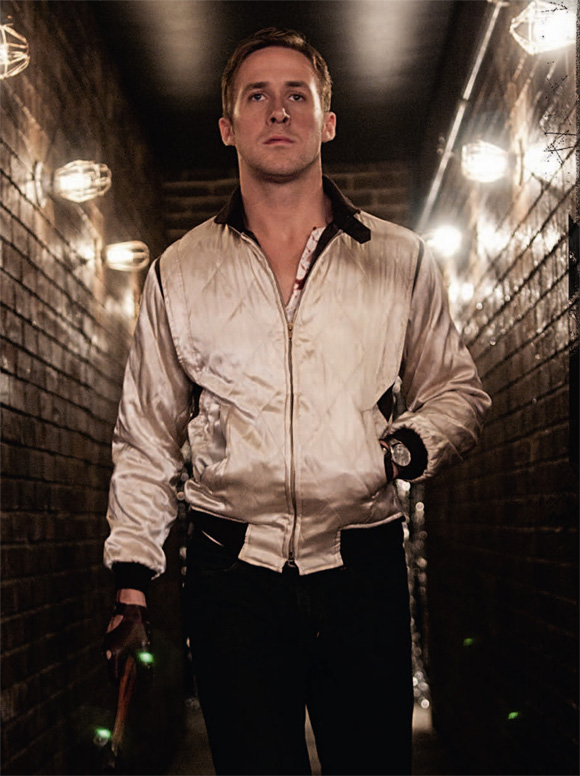
Yeh've got a long way to walk, Mr. Gosling.
 vaguely-offensive