
 3 crampons out of 5

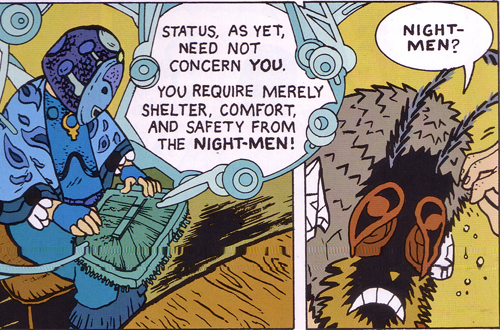
So look – I don’t know who this Jack Vance cat is. Reading “The Moon Moth,” which was adapted by artist Humayoun Ibrahim from a “classic” story by Vance, has definitely made me want to check the guy out. My sci-fi is lacking, but some of the stuff I’ve read that’s in the vein I would hope for – Ray Bradbury comes to mind – is almost too light on the sci-fi, just taking an idea and riffing on the social consequences and giving it a pulp feel. Iain Banks more operatic sci-fi is the other version of this style, but much heavier on the development of the world with the commentary taking a more indirect role in the story. But between these there would be a nice middleground of fully realized sci-fi plus commentary that doesn’t go on for 600 pages but is expansive enough to explore the culture a bit. And based on “Moth,” Vance might seem to fit that bill.
So that’s a plus. Ibrahim’s adaptation of the novel made me want to read the source work. But what of poor Ibrahim? Will I be following him elsewhere?
“Moth” was an easy read. Nice colors, a nice size, and a clear style that’s obviously indie but consistent enough to feel like a style and not just sloppy indie work. By the same token, there’s something very humble about the presentation that doesn’t convince that it benefits from being in comic form (except that it introduced me, potentially, to a new author I’ll enjoy). There are many interesting aspects to Vance’s story – a diplomat visits a unique culture and must learn to blend in in order to capture a criminal. But blending in is, actually, out there. Learning the language isn’t enough. “Prestige” is the only currency, and everyone wears masks that imply their level of prestige, playing specific instruments when they speak to represent their tone or expectation. While many stories would be content to toss these aspects in and just sit back, confident that the spin they’ve given is enough to move the story forward, Vance (or Ibrahim… who knows at this point) develops these aspects of the culture for the reader over the course of the short story… they are actually integral parts of the tale, boons and roadblocks to the progress of the main character’s goal, and are fully realized as more than just nifty details within a few pages. Perhaps that’s some of the appeal for Vance fans, seeing these masks and instruments represented, but as the tale can now rely on visuals, it requires flipping back and forth to a guide on the instruments to double-check what means what. The masks, also, are explained to us and shown, but I wonder if our imaginations couldn’t do their representations more justice, along with however the narrator of the story (or an omniscient narrator) would’ve described the look might’ve helped to embellish our visualization of these things all the more.
But back to Ibrahim. His humans are a bit amateurish looking, but faces are soon covered up by masks and then fit with the overall loose style. It’s tough ranking this as the first work of his I’ve read. If it had been an original story, I’d probably be massively impressed by the scope. As is, I can only go on acceptable art and that the story was adapted in a manner that I was able to read and enjoy.
Vance’s tale ends up stumbling a bit with the actual plot, as the criminal aspect feels sloppily input as a way of adding some intrigue. There’s also a super long introductory blab by some Vance fan that crosses the line from celebrating the guy’s work to calling you an idiot for not having read it and appreciating it already. It’s overlong and unnecessary. Sorry, Vance fan. I’m sure you’re famous.
A very interesting premise that loses a bit of ground thanks to trying to work itself around a story and being indie-ized for a small press comic.
 vaguely-offensive