
 4 crampons out of 5

I haven’t read too much sci-fi, or at least not enough to consider myself a specialist in the genre. I’ve read some of the notable cyberpunk stuff, but though I touted it as cool, not much of it stuck to except for Neal Stephenson. By my opinion, Stephenson is a better writer than some of his peers, or at least more literary, and that worked better for my reading sensibilities. I came to Iain Banks through his fiction work (written without the M. middle name). While the majority of his works are less verbose than Stephenson – 500 pages vs. 1000 – there is a similar sense to the detailing and the heavy dependance on fully developed characters, side or main. Banks, though, tends to get more depressing.
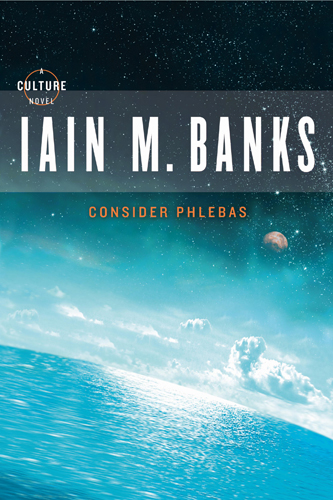
‘Consider Phlebas’ was the first in what would become Banks’ “Culture” series which seems to show a functioning, almost utopian society, and instead of deconstructing the impossibility of that being a reality, a la 1984 and its ilk, instead takes a realistic approach to it, and shows what being human (i.e. not perfect) can mean in such a culture. But Consider Phlebas is way before we get to that point. It takes place in the midst of a war between the Culture and the Idirans, the Culture with their dedication to technology and acceptance and the Idirans with their belief in war and expansion. Stated as such it’s easy to cast one side as good and the other bad, but our lead character – Horza – is on the Idiran side, and thus, at least initially, so are we. Bora doesn’t believe in their aggressive tactics per se, but he sees the Culture’s position as an evolutionary dead-end, a dedication to machines that would one day get tired of their owners. By starting us here, we are in familiar sci-fi territory, as “Machines Take Over” is one of the several go-to plots for future tales. Though the scope broadens, as Horza has to make concession after concession to achieve one tiny goal for his cause, and with each step that goal becomes less and less clear as to its import.
A primary component of Banks’ world are “Minds,” Culture creations which are essentially incredibly powerful computers, capable of human-like thought and replicable emotions but with X to the power of X in terms of memory recall and intelligence. A very powerful Mind escapes from a Culture ship moments before destruction by the Idirans and hides in a region of space only accessible by The Changers, a race of shape-shifters to which Horza belongs. The Idirans thus recruit Horza to retrieve the Mind, but the mission to send him thataway gets complicated, and Horza finds himself first adrift in space and then picked up by a group of profit-seekers aboard a small ship called the Clear Air Turbulence. Needing to earn their trust and wary of the ship’s crew’s views of the Idirans, Horza hides his true nature and goal. This is the first of many diversions he’ll have to take to get to where he’s going, with plenty of death and destruction to muddy the moral waters.
As long as it keeps moving, “Consider” is amazing. There are moments of palpable intensity, where you truly don’t know what event is around the corner, and taking place in such a high-tech but recognizable world you can understand and see these scenarios while reading and it’s truly like experiencing an excellent sci-fi film. But, at moment, the book comes to a dead stop. In an attempt to do some world building, we are introduced to some other characters in interlude chapters. It’s important for making an overall point with his story, but after 100+ pages of Horza working toward his goal, ten pages of philosophical wandering from a side character doesn’t blend, and adds on top of the down moments Horza experiences while traveling from scene to scene, contemplating his travels and actions. Oppositely, when the action becomes intense and it requires details from several points of view, Banks’ suddenly hops from character to character, and though it’s mostly understandable, the lack of that style in other moments of the book makes it feel somewhat sloppy. But this was early in his career and can be forgiven for how overwhelmingly satisfying the major scenes are.
It also helps that, while absolutely acting as a space soap opera – betrayal, romance, high action – “Consider” elevates the genre (and the series) by giving us things to consider about the events in the book. Sci-fi can certainly act as commentary on the world, but it’s broader than that. There are large questions at play here that are unexpected, and snapped on satisfyingly with an epilogue that summarizes the after effects of the Culture/Idiran war. Instead of beating us over the head with these issues directly, the character’s actions speak for themselves, and then we get a few pages of post-script for us to mull over. The other boon is the level at which Banks approaches science fiction. Sometimes it’s cool to have a list of exclusive terms or concepts to refer back to, but unless the story can really justify it and you’re not just substituting ridiculous words for common things, it can get annoying. The same things goes for tech in sci-fi. We can all imagine some badass things that we can’t explain how, exactly, they function. Sci-fi writers are good at hiding this, extrapolating a concept into the future then disguising the lack of wires powering it with some throw pillows. But it feels sort of counterfeit once you’re past the shiny surface. In “Phlebas,” and the books to follow, the tech feels legit, it feels like a logical advancement of the direction technology has always taken. We will still create, and still walk on the ground, and still eat, and still gamble, there’s just better technology and knowledge to support that.
But I’ve already waxed on for too long. This is a classic book on which opinions have already been formed. The moments that are slow are almost slow enough to set the book down permanently, saved by the knowledge that in a few pages you’ll get back to the story proper. But that proper story is such an awesome trip that’s it’s worth those stops.
 vaguely-offensive